Do you remember your third-grade teacher’s name?
Hold onto that picture for a second. A kid that age. Times tables. Recess. A backpack that’s a little too big.
Now imagine this.
You’re in third grade, and your dad gets killed — by the people who work for him. His own staff.
Then it gets stranger. The people of your town hunt down the ones who did it, and kill them too.
Now the part that rearranges your whole life: your dad was the king. Which means the job doesn’t sit empty.
It’s yours.
You. Third grade. Running a country.
One more thing you should know, because it matters. Your family has history. Your grandfather ran the place for fifty-five years, and he was, by every account, a bad dude — the kind who spends half a century tearing down the very thing the country was built on. And your father, the one who just got killed? Two years on the job, and already headed down the same road.
That’s the family. That’s the inheritance.
That’s where Josiah starts.
Now roll the clock forward. He’s twenty-six.
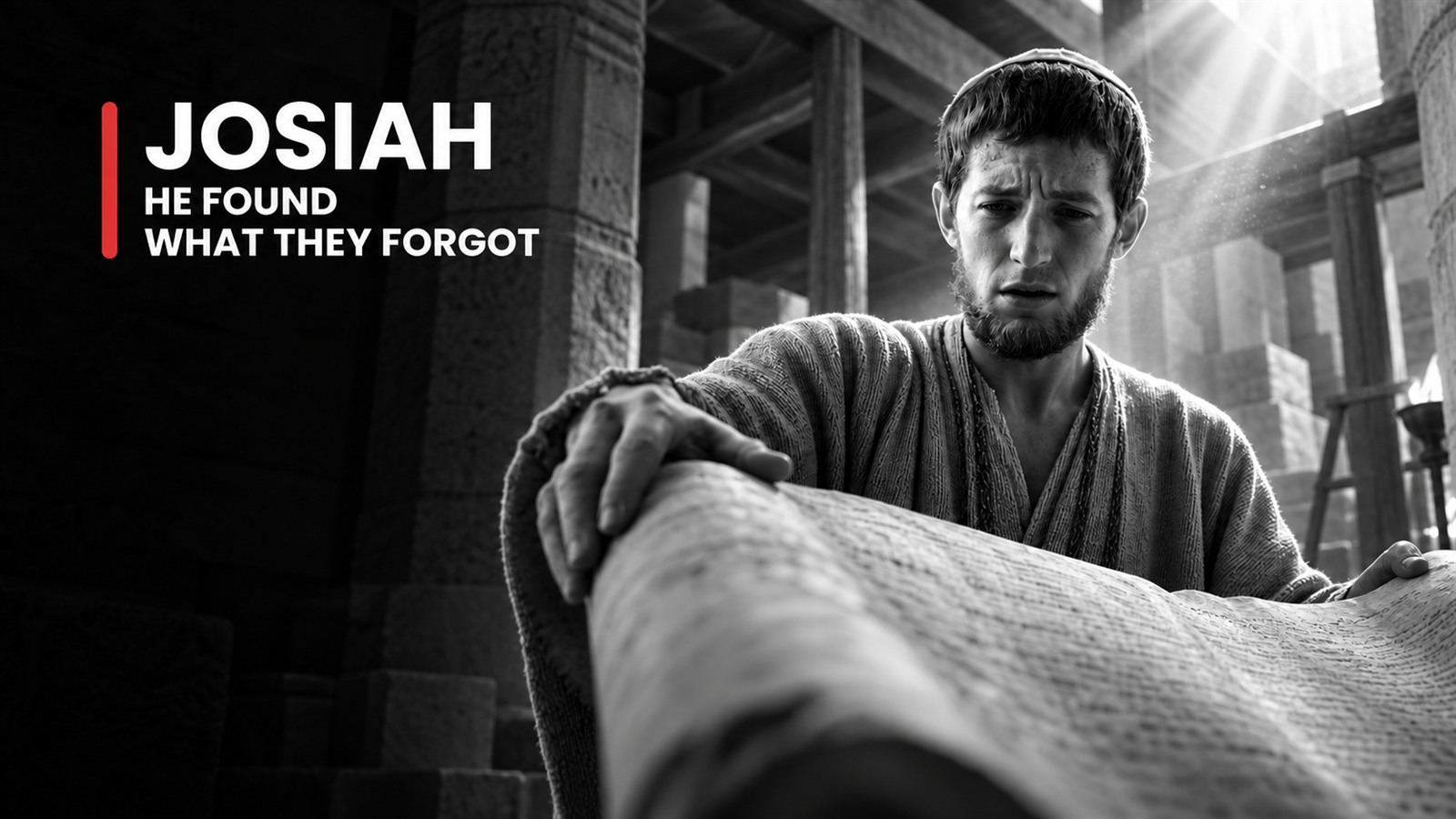
And here’s what he’s doing at twenty-six: he’s running a renovation. The national temple — the most important building in the country — is getting restored. Rotten timber pulled out. Foundation repaired. Crews on payroll. Budget managed. Real, visible progress.
Then a worker finds something buried in the walls.
A scroll.
Not a memo. Not a copy of last year’s plan. This was the founding document — the original charter that spelled out who these people were, what they were for, and how they had agreed to live. Every law. Every promise. The whole reason the nation existed in the first place.
It was the answer to “why are we even here,” written down once, at the beginning — and then lost.
Missing for decades. Buried inside the very building built to hold it. Gone so long that when they finally read it out loud, there’s a good chance not one person in that room had ever heard the words.
An entire nation had been running — collecting taxes, fighting wars, renovating its own temple — without the one document that told it who it was.
Josiah tears his clothes.
Not a figure of speech. He literally rips them.
Because it lands on him all at once: they hadn’t just misplaced a book. They’d lost the plot. The building looked incredible, and nobody inside it could have told you what it was for anymore. The renovation was skin-deep. The drift went all the way to the bottom.
Here’s what’s easy to miss.
Josiah wasn’t lazy. He wasn’t asleep at the wheel. He was already doing good work. The renovation was real. People were employed. The budget balanced. The system ran.
But good work and right work aren’t always the same thing.
I can run an efficient operation pointed in the wrong direction. I can polish a process that shouldn’t exist. I can hit every number and miss the entire point.
This was my first corporate job, in the late 1980s — back when artists didn’t have computers. That’s almost impossible to picture now, but it’s true. Computers were for accountants. A creative department ran on drawing boards, pencils, wax machines, and X-Acto knives.
So moving about three dozen board artists onto machines wasn’t a software update. It was asking a room of people to give up their hands.
Part 4 of 5 · ProfileMeet Josiah: the full profile →Character profileI took it seriously. I hired a consultant from my alma mater to run the transition — pulled her in from Art Center, where she was leading the exact same digital shift. We poured ourselves into their morale, their pace, the tablets that they would need, proper chairs to sit on because the board were being removed, whether the whole change would break them.
And with all that care, all that expertise in the room, I missed the most obvious thing. Production went to a standstill. They couldn’t type.
I totally missed it.
I’d handed a team of career artists a tool they couldn’t physically operate. So before we made a single beautiful thing on those Macs, they all went back to typing school.
That was my scroll. Not a vision. Not a strategy. Typing — the one thing so obvious I’d stepped right over it.
And that’s the thing about a scroll. It rarely goes missing because it’s rare. It goes missing because it’s basic — because it sits underneath everything, which is exactly why you stop seeing it.
Josiah didn’t have to go acquire anything new. The scroll was in the building the whole time. He just had to rediscover what was already his — and then find the guts to hold everything he’d built up against it.
So here’s the only question that matters.
Not: are you busy?
Have you found the scroll?
Or better said, have I found the scroll?
Note: The whole story lives in two parallel accounts: 2 Kings 22–23 and 2 Chronicles 34–35. Chronicles tells it with a bit more detail on the reforms; Kings is the tighter narrative.
Get it by email, free
One Bible character and one leadership lesson, every week.