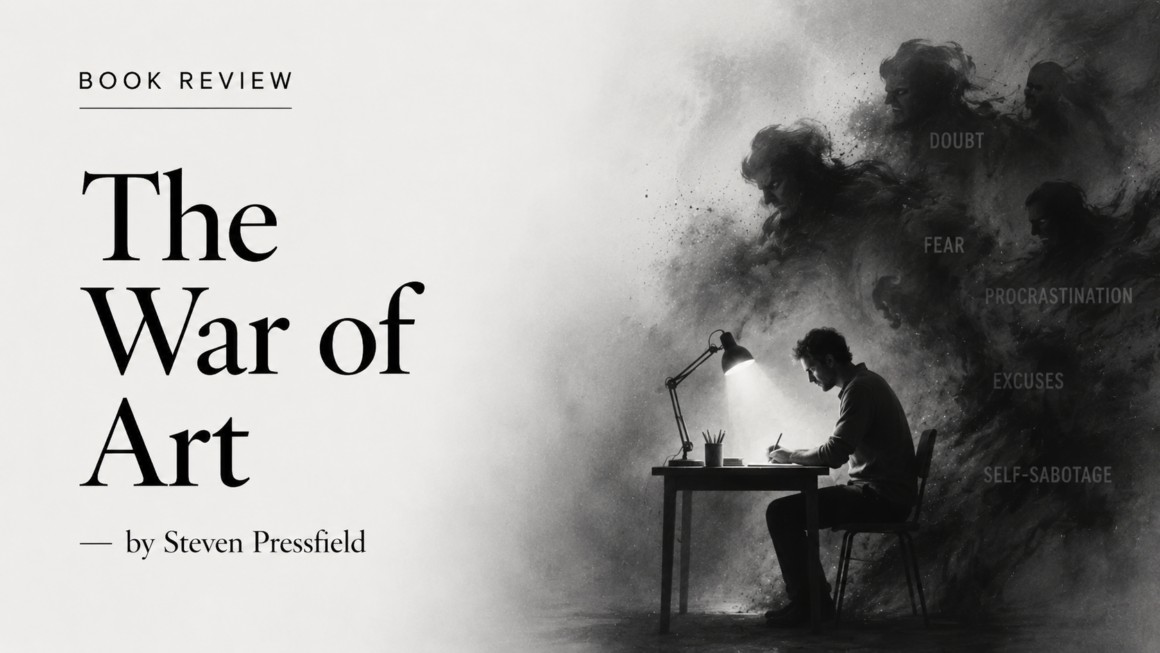
Steven Pressfield published The War of Art in 2002. He was already a novelist by then — The Legend of Bagger Vance, Gates of Fire — but this was his first non-fiction book, and it changed his audience. It has become required reading in surprisingly different circles. Writers, athletes, entrepreneurs, pastors.1
The book is short. Maybe two and a half hours to read straight through. Each section is a page, sometimes two, with hard returns between paragraphs. It is built to be re-read.
Pressfield’s central move is to give the enemy a name.
“Rule of thumb: The more important a call or action is to our soul’s evolution, the more Resistance we will feel toward pursuing it.”
He capitalizes the R on purpose.
What It Actually Does
Pressfield argues there is a single force standing between every person and the work they were made to do. He calls it Resistance.
Resistance is procrastination. Resistance is the urge to check your phone. Resistance is rationalization. Resistance is fear. Resistance is the inner monologue that says not yet, not you, not today.
The book is built in three parts. Book One defines Resistance. Book Two lays out what it looks like to fight it as a professional rather than an amateur. Book Three is more mystical — Pressfield writes about the Muse, about angels, about a higher source that meets the person who shows up to do the work.
Book Three is where Christian readers will start translating in real time. Pressfield is not writing from a Christian frame. He treats the divine as real but does not name it the way scripture does.
The diagnosis still holds. He has named something true about human nature whether or not his metaphysics line up with yours.
Why It’s on the List
False humility is Resistance.
“I couldn’t do that.” “Who am I to think I could.” “Maybe next year.” Every line of it is Resistance dressed in church clothes.
Pressfield says it plainly:
“Resistance will tell you anything to keep you from doing your work.”
He is right, and he gets to use the language he wants because he is not a pastor.
If the parent post named the problem, Pressfield names the enemy that keeps the problem in place. That alone is worth the two and a half hours. You cannot fight what you have not identified.
There is one more line worth carrying with you:
“The more scared we are of a work or calling, the more sure we can be that we have to do it.”
That sentence is the secular twin of the question from the parent post — what would you do if you knew you couldn’t fail. Both point at the same instinct from opposite directions. Both are asking what you are hiding from.
One Honest Note
The third section of the book trades in muse-and-angel language that doesn’t map cleanly onto Christian theology. Read it as Pressfield’s best attempt at naming a real thing — the experience of being met by something larger than yourself when you finally do the work — and add your own theological frame.
Some readers want more depth from a book that hits this hard. The aphoristic style is the format. It is the point, not a shortcut. You’re meant to come back to it.
Read it. Underline the lines that sting. Put it on the shelf where you can grab it on the days the script starts running.
Then sit down and do the work.