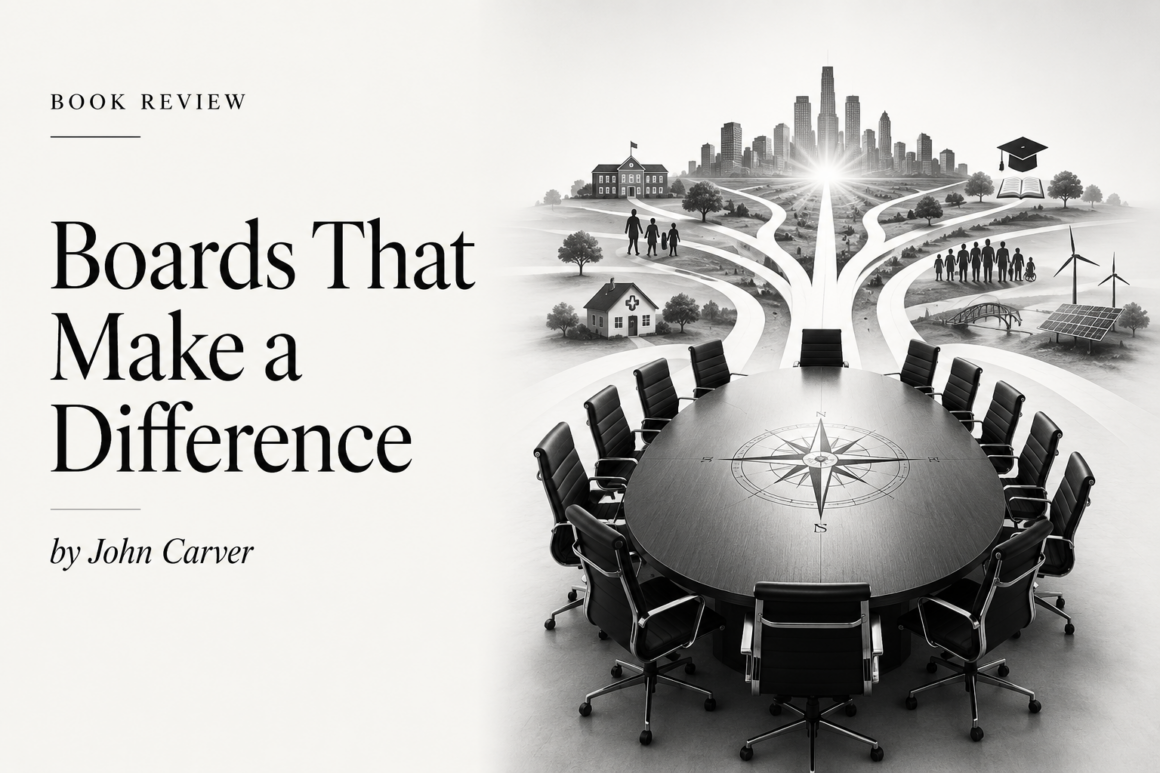
Some books get handed to you. This is one of them. If you have served on a nonprofit board in the last thirty years, there is a decent chance a copy of John Carver’s Boards That Make a Difference landed in your lap during a training, showed up in an onboarding packet, or got pressed on you by a chair who had seen the light. Other boards stumble upon it on their own, usually around the third meeting, which ends with everyone tired and nothing decided. However, it reaches you; it reaches a lot of people. The book is a classic, and it has earned the word.
I want to distill why, because distilling is the whole point. Carver’s argument is simple enough to say in a paragraph, and most of the book is him defending that paragraph against every objection a board can throw at it.
The one idea
Here it is. A board’s job is not to help run the organization. Its job is to decide what the organization is for — what good it should produce, for whom, at what cost — and then to draw a bright line around what it will not tolerate in the pursuit of that good. Everything inside the line belongs to the people doing the work. The board governs by stating values, not by approving plans.
That’s it. Carver calls the model Policy Governance, and once you see the distinction underneath it, you can’t unsee it. He splits every board question into ends and means. Ends are the difference you intend to make in the world. Means are how anyone goes about making it. Boards, he argues, drown because they spend their evenings in the means — reviewing, approving, tweaking work they are not close enough to judge — while the ends, the only thing a board can truly own, get five minutes at the bottom of the agenda.
Flip it. Decide the ends with care. Set the outer limits on the means in writing, so a “don’t cross this” list gives your staff and volunteers bounded freedom rather than a guessing game. Then get out of the way and hold people accountable only against what you actually wrote down. A board that does this speaks with one voice, stops nitpicking, and starts leading.
Why it lands
What makes the book a classic is not that the idea is comfortable. The idea is clean. Carver gives a board a way to tell the difference between its own work and everyone else’s, and most governance trouble turns out to be a version of that line getting blurred — a committee quietly directing staff, a chair supervising the director, a well-meaning member walking over to “just help.” Name the line, and a lot of chronic friction has a cause you can fix.
I’ll be honest about the other side, because the better reviews of this book are. Carver asks a great deal. “Accept any reasonable interpretation of your own words” is a hard thing for an anxious board to actually do, and plenty of boards adopt the vocabulary without the trust and end up with new words for old control. Critics have called the model rigid, even doctrinaire — Carver later added a whole chapter answering that charge. And the pure form can feel like a lot of machinery for a small organization. Fair. But I have never seen the core distinction — ends versus means, own your policy, monitor only what you wrote — fail to make a board clearer about its job. You can take that much and leave the machinery.
Read it — and what to read with it
Read Boards That Make a Difference for the idea, not as a rulebook to install verbatim. Take the ends-and-means split, the one-voice discipline, and the habit of governing by written value, and let the rest earn its place in your context.
If you want to go further, three books pair well with it. Chait, Ryan, and Taylor’s Governance as Leadership is the natural companion and the friendliest counterweight — it preserves Carver’s seriousness about purpose while giving the board a richer, more generative role than pure Policy Governance allows. Carver and Bill Charney’s The Board Member’s Playbook is the practical follow-on, working the model through real problems when you’re past theory and into “so how do we actually do this.” And for anyone applying this in a congregation, Dan Hotchkiss’s Governance and Ministry translates the same instincts into the life of a church better than a straight reading of Carver will.
Start with Carver, though. Read the first hundred pages, sit with the ends-and-means idea for a week, and watch how differently your next board meeting looks. That’s the test of a classic — it changes what you notice. This one does.