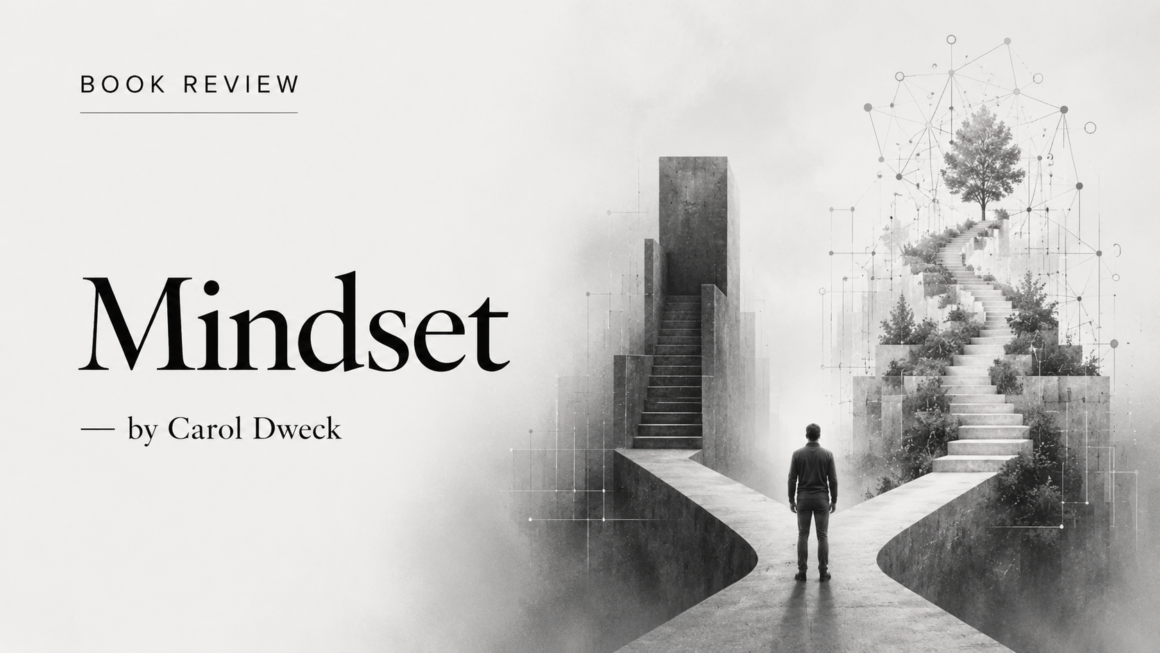
Carol Dweck published Mindset: The New Psychology of Success in 2006. It became a million-copy bestseller and is now used in education, business, sports, and parenting in ways that have outpaced what its Stanford psychologist author probably expected. An updated edition came out in 2016 with new chapters.
Dweck is the Lewis and Virginia Eaton Professor of Psychology at Stanford. She did decades of research on motivation, personality, and how people respond to setbacks before writing the book. The research is the spine. The book is the popular version.
The thesis is one sentence:
“Your view of yourself can determine everything.”
She is not being rhetorical. The way you think about your own capacity shapes what you attempt, what you avoid, what you finish, and what you walk away from.
What It Actually Does
Dweck argues there are two basic stances toward your own abilities.
Fixed mindset — you believe your intelligence, talent, and character are essentially set. You either have it or you don’t. So you spend most of your energy proving you have it. You avoid challenges that might expose what you lack. You take criticism personally.
Growth mindset — you believe your abilities can be developed through effort, good strategy, and learning from people who have done it before. So you lean into challenges. Feedback is information, not a verdict. Failure is data, not identity.
The book builds out from there. She walks through what fixed and growth mindsets look like in school, work, sports, marriage, and parenting. Each chapter is grounded in actual studies, often her own.
A useful detail: in the 2016 edition she introduces what she calls false growth mindset — the watered-down version of her idea that has spread across schools and HR departments. Saying “I have a growth mindset” doesn’t make it true. The actual work is harder than the slogan.
Why It’s on the List
False humility is a fixed mindset applied to your own life.
“I couldn’t do that.” “I’m not the kind of person who…” “Who am I to think I could…” Every line of that script assumes your capacity is fixed and small. It is the same mental move as a kid saying I’m just bad at math — except now it sounds spiritual.
Dweck offers the secular grounding for what the parent post argued from scripture. She is not writing as a Christian. She does not have to. The research lands at the same conclusion: people who believe they can grow into something more usually do, and people who believe they can’t almost never do.
If the parent post named the problem and Maxwell handed you the workbook, Dweck shows you the studies. For some readers, that’s exactly what they needed to take the work seriously.
One Honest Note
Mindset has had its critics inside academic psychology. Some replication studies have found smaller effect sizes than the original research suggested. The popular version of the idea has also run ahead of the science in places, which is part of what prompted Dweck’s own false growth mindset correction.
None of that disqualifies the core insight. People with the growth mindset do recover better from setbacks. They do take on harder challenges. They do tend to develop further over time. The mechanism is real, even if the magnitude in any one study varies.
Read it for the framework, not for the slogan.
And add your own theology while you read. Dweck won’t tell you who put the capacity in you. The parent post will.