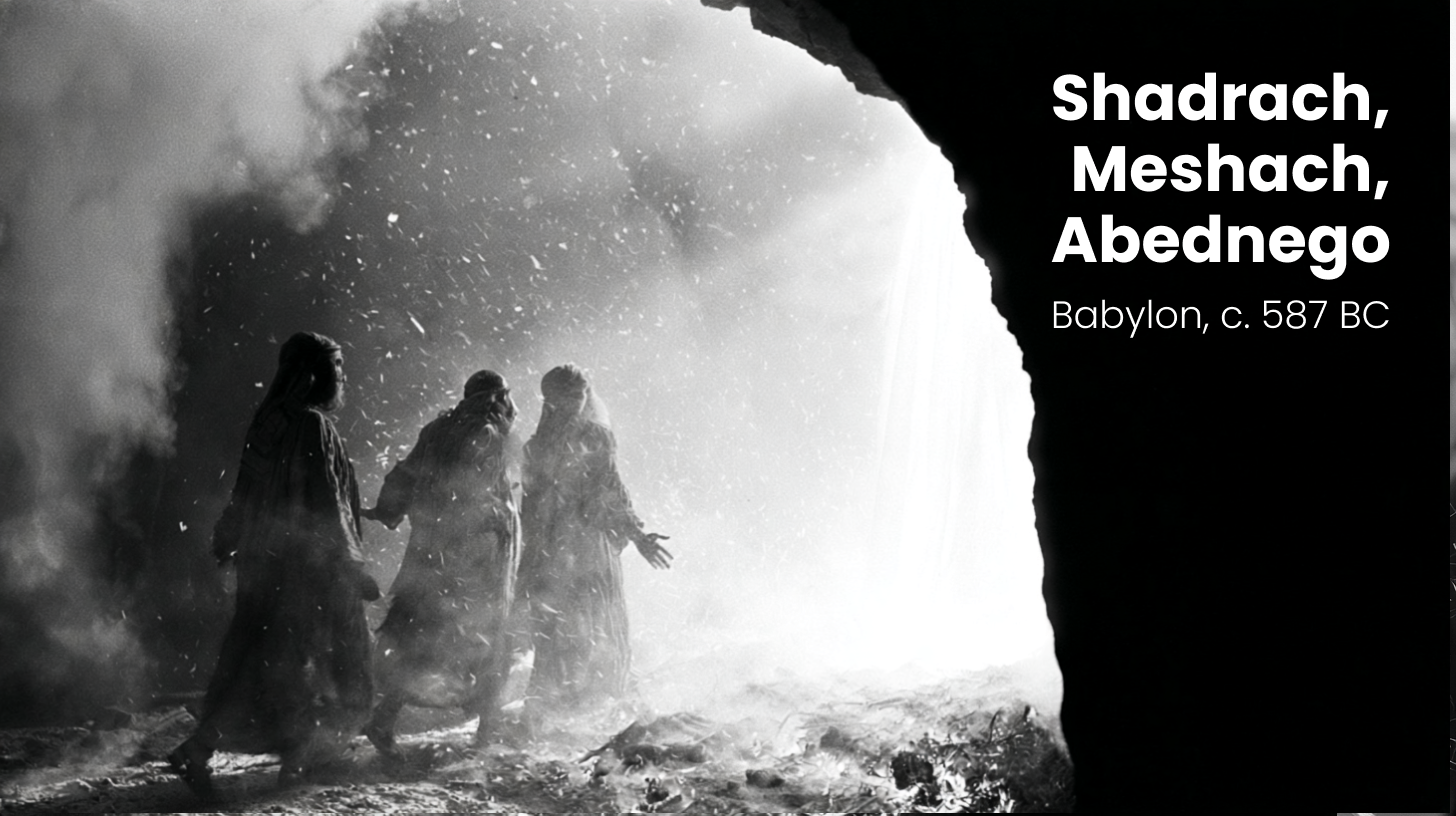
They were teenagers when Babylon took them — maybe fifteen, marched out of Jerusalem with the rest of the useful boys. Twenty years later they were middle-aged men running a province for the king who took them. Foreign administrators in a foreign government, loyal to their captors and faithful to their God. They had careers by then. They had something to lose.
Then Nebuchadnezzar built a statue ninety feet tall and called the whole administration out to the plain of Dura.
When the music played, everyone bowed. The penalty for standing was fire.
Three men stayed on their feet.
Here’s where it gets interesting. The king offered them a second chance — bow now, or burn — and mocked their God on the way out: “What god will be able to rescue you from my hand?” (Daniel 3:15).
Their answer is the whole story.
“We do not need to defend ourselves before you. If we are thrown into the fire, the God we serve is able to deliver us. But even if he does not, we will not serve your gods” (Daniel 3:16–18).
Even if he does not.
I make most of my decisions on expected outcomes. I run the odds. I hedge. I commit with an exit already picked out.
These three cut the outcome out of it. Their obedience wasn’t priced against God’s intervention. They weren’t betting on a rescue. They were saying who they were.
The furnace got heated seven times hotter. The soldiers who carried them died at the mouth of it. Then there was a fourth figure walking in the flames (Daniel 3:25), and the three came out with their clothes intact and no smell of smoke on them. Hebrews 11:34 remembers them as the ones who “quenched the fury of the flames.”
They couldn’t have known any of that was coming. The miracle came after the commitment, not before.
That fourth figure is the part I keep sitting with. Not someone who kept them out of the fire. Someone who was in it with them.
The decisions that have defined me are the ones where I couldn’t see the ending. Making the right call when it’s guaranteed to work has never cost me anything, and it has never told me anything about myself either.
“Even if he does not” is the posture of someone who already did the math. Counted the cost. Accepted the worst case. Decided their integrity outweighed their survival.
That’s not recklessness. That’s clarity.
When you take the outcome out of the equation, you find out what you actually believe.