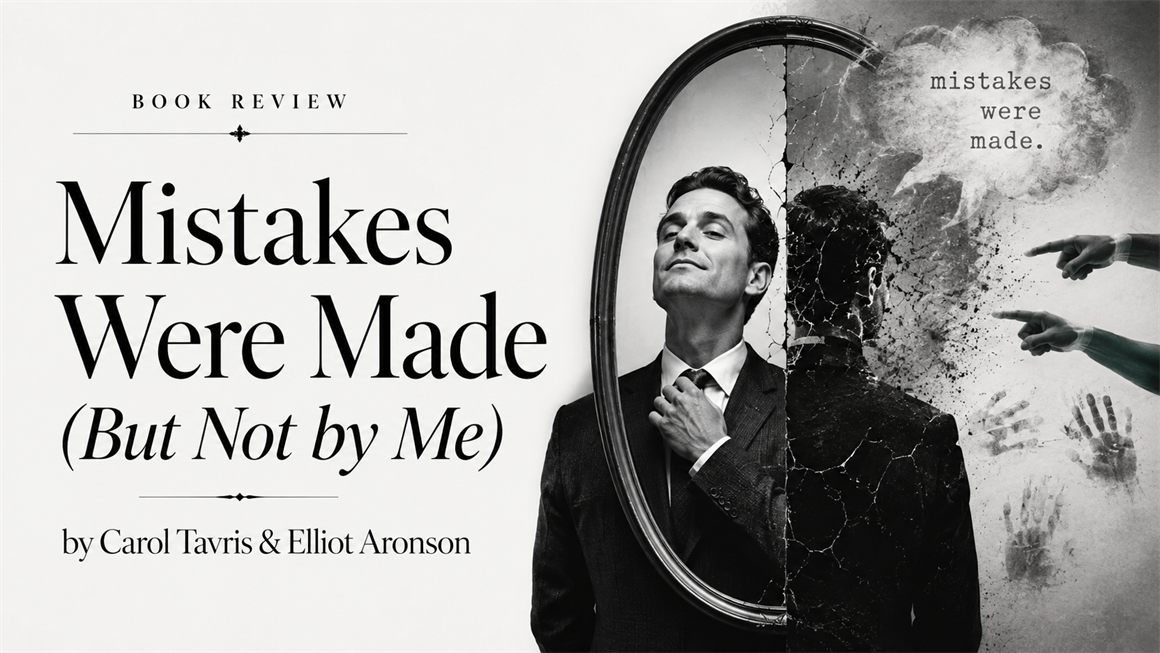
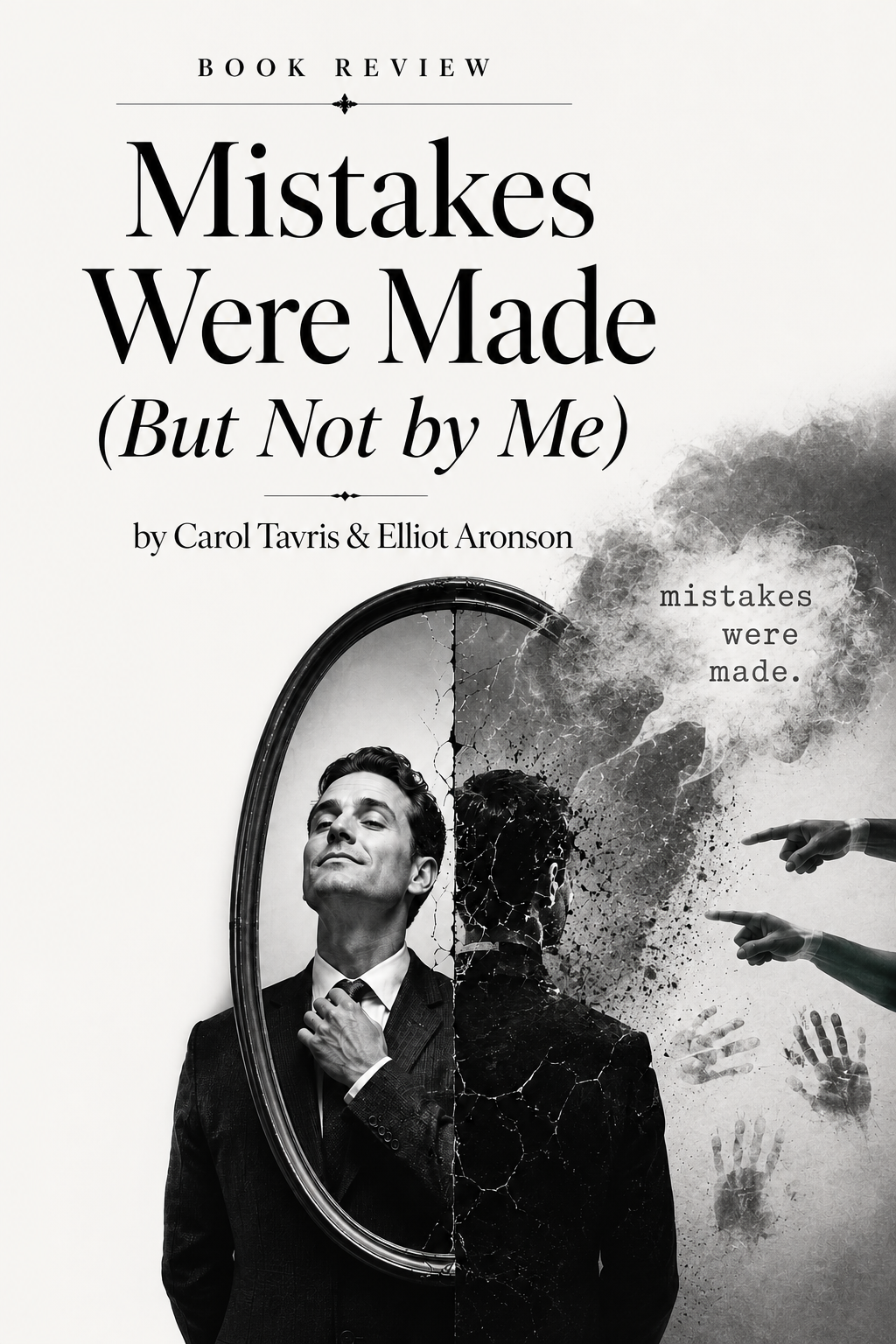
The title is a con, and that’s the point. It’s the phrase you hear when someone powerful gets caught — passive, ownerless, mistakes were made — as if the mistake wandered in on its own and no hand was ever on it. Tavris and Aronson build a whole book on that sentence. Not to mock it. To show me I say it too.
Their claim is simple and hard to shake. My mind can’t stand the gap between “I’m a good, smart person” and “I did a dumb or hurtful thing.” So it closes the gap — not by changing what I did, but by editing the story until I come out reasonable. They call the engine cognitive dissonance and the reflex it triggers self-justification. Memory does the cleanup, quietly rewriting the tape so the version I keep is the one where I was right.
The picture that stuck with me is the pyramid. Two people stand at the top, almost touching, facing one small choice — fudge the number, tell the small lie, stay or walk. One leans a little this way. One leans a little that way. Then each begins defending the step already taken. By the bottom they stand miles apart, both certain they were right the whole way down. The distance didn’t come first. The small step did, and the certainty grew up around it like a shell.
What makes the book land is where the authors aim it. Married couples, each keeping a private ledger of the other’s failures. Prosecutors handed DNA that clears a man they put away — who argue against the evidence rather than against themselves. Interrogators who coax an innocent person into confessing and never question the method. Doctors sure the drug rep’s free lunch changed nothing. The more committed and the more capable the person, the more convincing the story they build to stay innocent.
Here’s the line I can’t put down. Awareness doesn’t grant immunity. Naming the mechanism cold — diagramming the pyramid, quoting the studies — buys me almost nothing in the one moment it would matter. The authors admit they catch themselves doing it, and they wrote the book. That should have reassured me. It did the opposite. If the two people who mapped the trap still step in it, my map won’t save me either.
That’s the uncomfortable center. I had always assumed that seeing a flaw was most of the work of beating it. This book takes that assumption apart. Spotting the flaw in someone else is effortless — I do it all day. Catching it live, in myself, while my self-image is on the line, is a different act entirely, and no amount of reading hands it to me for free.
So what do I do with it? Less than I’d like. The authors don’t sell a cure. What they offer is smaller and more useful: treat the discomfort of being wrong as information, not as an alarm to shut off. Hold the mistake apart from my worth, so I can admit the first without surrendering the second. And distrust the tidy story — especially the one that arrives fast and flatters me.
If you want one book on why knowing better so rarely turns into doing better, start here. It won’t make you immune. It might make you a little harder to fool — beginning with the fooling you do to yourself.