Robert Trivers
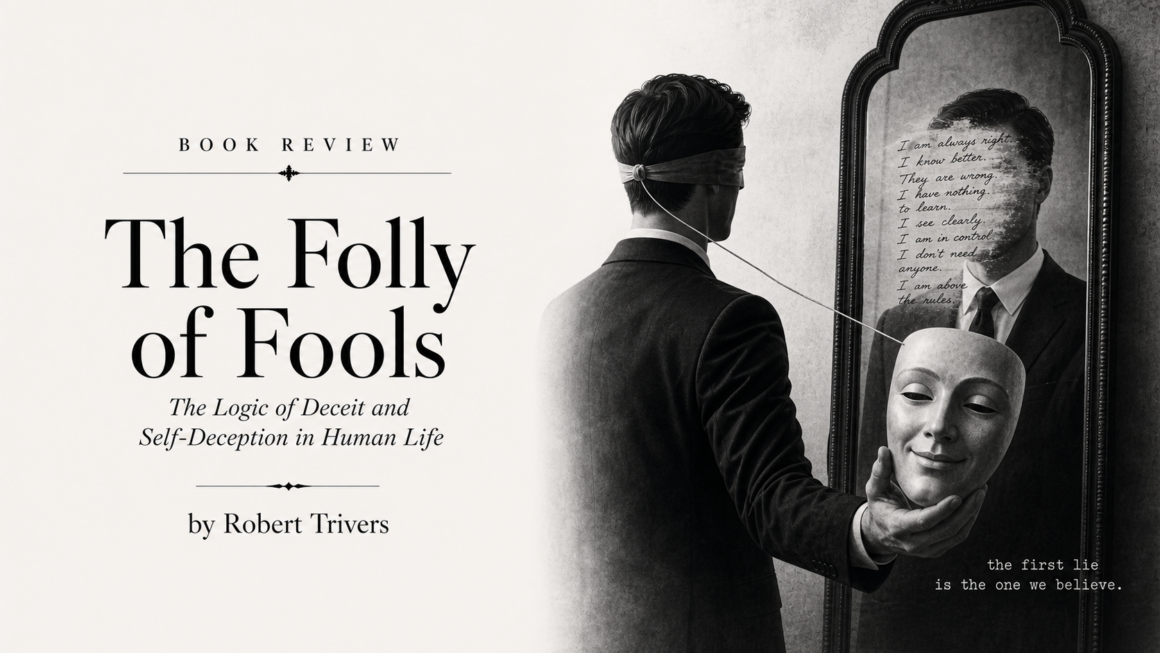
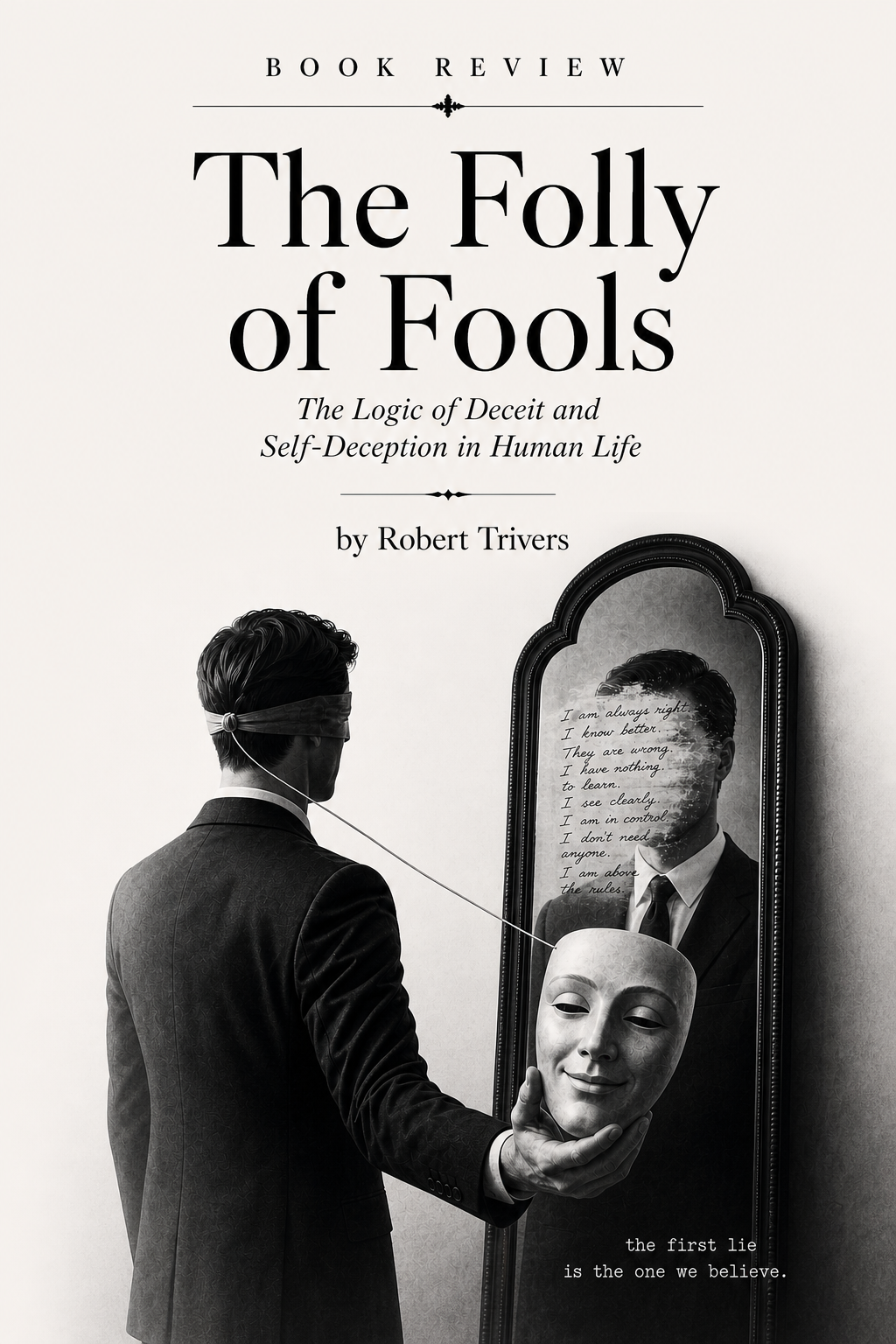
Most of the books on this shelf treat self-deception as a malfunction — a bug in otherwise good equipment. Robert Trivers wrote the one that says it’s a feature. And once I’d read his version, the others felt a little naive.
Trivers is an evolutionary biologist, one of the field’s giants, and he comes at the question from an angle that reframes everything. Deceiving other people pays off — it long has, for any creature that can manage it. But there’s a problem: we’re wired to catch liars. The darting eyes, the too-fast denial, the tell. So how do you lie without leaking? His answer is the thesis of the book, and it’s genuinely unsettling. You believe the lie yourself. If the falsehood never reaches my conscious mind as a falsehood, there’s nothing to leak. The best liar is the one who doesn’t know he’s lying.
That single move flips self-deception from weakness to weapon. I’d always assumed I fooled myself to feel better — to soften a failure, protect my ego, get through the night. Trivers says that’s real, but secondary. The deeper engine is offense: I fool myself so I can fool you, more convincingly than a conscious liar ever could. The comfort is a side effect. The point is the con.
He builds it biologically first — deception runs all the way down, into insects and viruses and the immune system — and then he lets it loose on human life, which is where the book gets its teeth. He reads airplane crashes and the space shuttle disasters as self-deception with a body count: whole organizations agreeing not to see what would have grounded the flight. He reads war and national history the same way — the flattering story a country tells itself isn’t an accident, it’s a tool for selling the war to its own people and the world. Families, religion, the social sciences he works in — he spares none of it, including himself.
Here’s why the book belongs at the end of this stack instead of the middle. The psychologists told me awareness of a bias doesn’t make me immune to it. Trivers explains why it can’t, at the level of design. If my mind evolved specifically to keep the truth out of my own awareness — to hide it from me so I’ll sell the lie with a straight face — then awareness was never going to be the fix. It’s the very thing the machinery is built to defeat. In his telling, a confident, sincere self-belief is exactly what a good deception looks like from the inside.
I’ll be straight about the book’s flaws, because it has them. It’s uneven — brilliant in the theory, then baggy and cranky when Trivers wanders off into his political grievances, and his prose can go murky right where you want it sharp. Some chapters read like a great mind talking past his editor. But the central idea is one of those rare ones that rearranges the furniture in your head and won’t quite put it back.
If you want the deepest and most disturbing answer to why smart, sincere people believe untrue things about themselves, it’s here: The Folly of Fools.
The line I carried out isn’t printed in the book; it’s what the book left behind. The lie I’d stake my life on is the one I can’t feel — because if I could feel it, it wouldn’t be doing its job.